

Does your workload need a quantum computer?
A promising quantum algorithm is only part of a usable computation. Data must be loaded, circuits must fit the available resources, and measurements must produce useful results. The Q-Alchemy Feasibility Suite brings these questions into one assessment, helping research and engineering teams decide how to run a workload and understand what is holding it back.
Public release: November 2026. The Feasibility Suite is available now for businesses, and customers can request early access ahead of the public release.
Assess the whole experiment
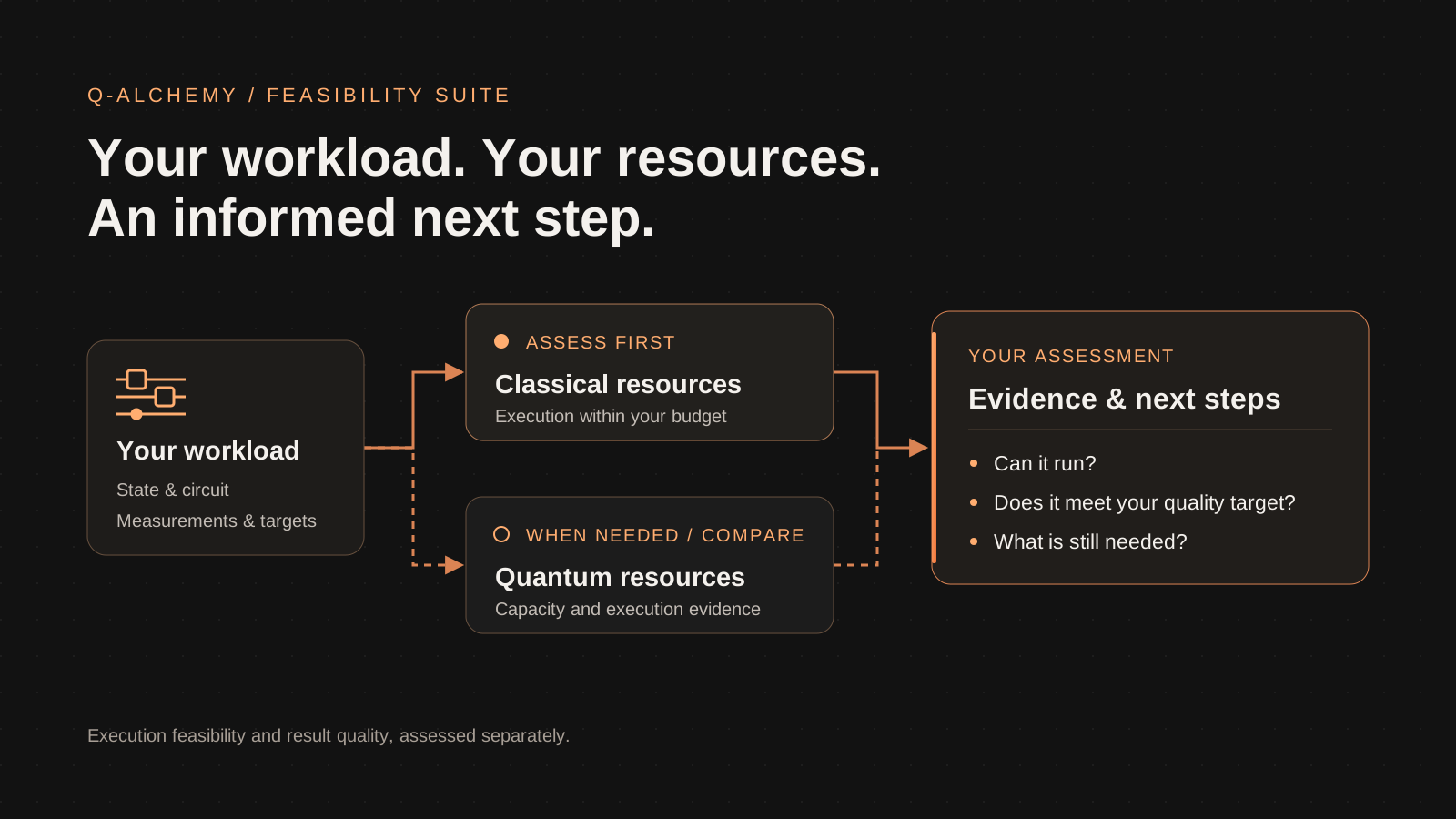
Start with the state you want to prepare, the computation you want to perform, and the measurements you need. Add your classical resource budget, the quantum resources available to you, and a quality target such as energy accuracy, observable error, or reconstruction fidelity.
The suite connects Q-Alchemy’s data loading, circuit compression, simulation, and result extraction tools. It assesses the complete preparation and computation circuit, records circuit costs, and brings execution evidence together in a report you can inspect.
- Classical feasibility. Establish whether the workload can execute within the assessed classical resource budget, including the memory needed for simulation.
- Quantum feasibility. Assess the configured hardware’s capacity and availability, and collect execution evidence when the selected workflow calls for it.
- Result quality. Check the available results against your stated criteria, showing which targets are met, missed, or still inconclusive.
- Resource gaps. Identify demonstrated constraints, such as insufficient classical memory or too few available qubits, and the next evidence needed to make a decision.
Use quantum resources deliberately
The default workflow assesses classical execution first. If the workload can run within the classical resource budget, it selects that route and reports quality separately. A missed accuracy target alone does not trigger a quantum job.
When classical execution is resource-infeasible, the suite can assess and use a configured physical quantum device. For benchmarking and research, an explicit comparison mode collects evidence from both paths, including a selected ideal or noisy simulator when appropriate. An offline mode supports assessments without quantum execution.
The report keeps two questions distinct: can this computation run with the resources available, and does its result meet the requested quality? It also identifies whether evidence came from hardware, simulation, or an estimate, so each conclusion can be read in context.
A console built around the decision
We are developing the Q-Alchemy Console as the browser interface for the Feasibility Suite. Its workflow starts with a workload, a quality target, and the resources you want to assess. It presents a plain-language verdict alongside the supporting measurements, circuit metrics, resource constraints, and execution history.
Workload inputs, jobs, and reports stay together, helping teams revisit an assessment and compare experiments. The console also supports inspecting state preparation and reconstruction, making it possible to follow the data from its classical description through execution to the information recovered afterwards.
From molecular workloads to a practical next step
Quantum chemistry is a useful starting point: a molecular state, its evolution circuit, and a target energy or reconstruction accuracy give the assessment a concrete purpose. Explore our quantum chemistry solution for the preparation, measurement, and reconstruction workflow demonstrated on IBM quantum hardware.
The Feasibility Suite helps you assess your own workload under your own resource constraints. Bring a use case, the resources you can access, and the result you need. We can help you plan a business evaluation or request early access before the November 2026 public release.