

Algorithm
Q-Alchemy constructs quantum state-preparation circuits from classical state descriptions. Its research basis includes Q-Tucker, described by Carsten Blank and Israel F. Araujo in Tucker iterative quantum state preparation (PDF, published chapter).
For a visual introduction and the paper’s numerical example, see the Algorithm overview.
Iterative decomposition
Section titled “Iterative decomposition”Q-Tucker factors a target state into a core and operators acting on qubit blocks. Repeated decomposition transfers structure from the core into circuit layers. The final factors prepare an approximation of the target from the all-zero input.
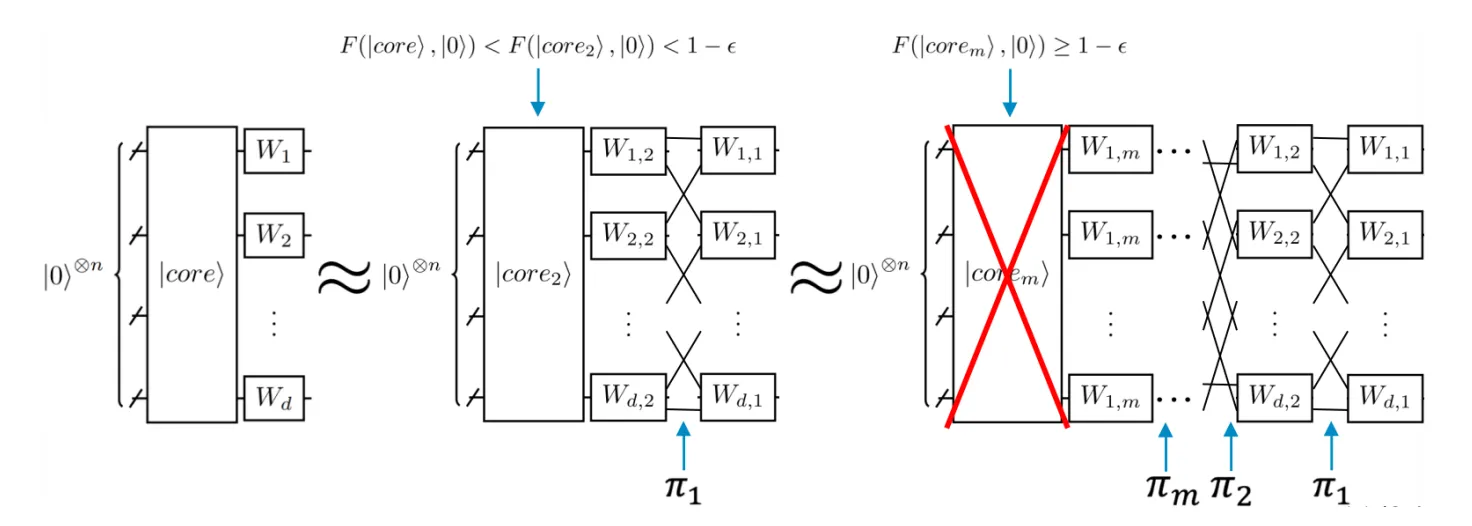
Circuit construction from Figure 1 of the paper.
The correlation graph guides block selection heuristically. The paper’s convergence argument assumes its specified gauge and permits block growth; it does not guarantee inexpensive convergence for every input under a fixed implementation budget.
Current automatic selection
Section titled “Current automatic selection”The production QAlchemyInitialize implementation evaluates distinct Tucker candidates that fit its resource limits. These include iterative variants and, for admitted inputs, a hierarchical variant. It reuses a correlation graph across candidates and compares their realized circuit costs.
The requested fidelity loss is a selection constraint. When candidates satisfy it according to their reported estimates, selection compares their circuit costs. If none satisfies it, the implementation returns a best-effort candidate, prioritizing the smallest reported loss. Inspect the selection report rather than assuming a returned circuit met the requested threshold.
This report includes the chosen candidate, selection reason, reported loss, circuit metrics, and attempted or omitted candidates. Exact fast paths also handle one-qubit inputs and eligible dominant-basis states. Candidate admission depends on qubit count and, for sparse inputs, the number of represented amplitudes.
The SDK exposes automatic and explicit initialization methods. See Options for the supported service parameters and SDK for usage. Specify the iterative method when passing iterative-only controls.
Accuracy and verification
Section titled “Accuracy and verification”max_fidelity_loss expresses the permitted loss relative to the target state. It is an approximation target, not a prediction of fidelity on a physical processor.
The initializer reports an algorithmic estimate; automatic selection does not independently simulate every candidate to certify its fidelity. When resources permit, simulate the returned preparation circuit and compare it with the intended target. For a complete experiment, also check the final observables, energy, distribution, or reconstruction criteria that matter to your application.
Logical circuit cost and hardware cost are different. Current candidate comparison compiles to a gate basis without physical placement, coupling-map routing, scheduling, or calibration-aware optimization. Final device compilation can add gates and depth.
Classical resources and state structure
Section titled “Classical resources and state structure”A dense n-qubit state has 2n complex amplitudes. Dense input storage remains exponential in qubit count, even when an algorithm handles the represented amplitudes efficiently.
Sparse input stores amplitudes at occupied basis indices. Its size can be much smaller, but the intermediate state may become dense during evolution. Low tensor rank is another form of structure; sparsity and low rank are distinct properties. Block size, iteration limits, partition search, and synthesis all affect preparation cost.
The dense-statevector memory table gives an explicit storage baseline. The sparse simulator documentation explains when classical validation remains practical.
Preparation in the complete workflow
Section titled “Preparation in the complete workflow”- Loading: construct a circuit for the target state, tracking approximation and logical circuit costs.
- Compression: search for cheaper equivalent circuit implementations for the intended input contract.
- Extraction: measure observables and, when configured, fit a compact state model. Reconstruction quality depends on the measurements, model, and noise.
- Assessment: the Feasibility Suite considers execution resources and reports quality separately.
The quantum chemistry solution describes a later hardware campaign that brings preparation, acquisition, and reconstruction together. Those hardware results are separate evidence from the state-preparation paper’s numerical study.
Research references
Section titled “Research references”- Blank and Araujo, Tucker iterative quantum state preparation (2026): arXiv:2602.09909, DOI:10.1007/978-3-032-13855-2_25.
- Earlier foundation: Low-rank quantum state preparation.